





Bitcoin vs Ethereum vs Litecoin: Key Differences, Features, and Which Is Better for You in 2026

Updated: Mar 24, 2026


Introduction
The “Bitcoin vs Ethereum vs Litecoin” question keeps showing up in 2026 for a simple reason: these three networks sit near the center of the cryptocurrency market and broader blockchain technology reality for cryptocurrencies. When comparing ETH vs LTC or ETH vs BTC, side threads like Bitcoin Cash and Bitcoin Cash vs Ethereum pop up too.
What’s the difference and the difference between Bitcoin narratives usually comes down to different purposes. Bitcoin continues to attract serious attention as institutions get more comfortable holding BTC exposure.
Ethereum’s proof-of-stake design has had time to mature, and the network now feels less like an experiment and more like established infrastructure for on-chain activity. Litecoin, quietly, still shows up in the places where people care about straightforward payments and practical transfers.
A good crypto comparison 2026 guide shows which cryptocurrency is better for a given goal. BTC, ETH, and LTC were built with different priorities, and those priorities still shape their security model, transaction fee patterns, user experience, and typical use. This article breaks the trio down, maps them to real scenarios so you can choose based on what you actually plan to do.
Let’s start with Bitcoin and Ethereum, and move on to Litecoin.
What Is Bitcoin?
Bitcoin is decentralized digital money that runs on a public Bitcoin network with no central operator. It operates on a decentralized network, without the need for a central authority or a third party.
Bitcoin, created by the pseudonymous Satoshi Nakamoto (often shortened to Nakamoto), is the first cryptocurrency (in other words, Bitcoin is the first cryptocurrency) and it remains the largest cryptocurrency by market cap.
It is designed around scarcity and resistance to censorship, with a fixed maximum supply and Bitcoin charts show a long track record of staying online through market cycles, forks, and shifting narratives.
In the “Bitcoin vs Ethereum vs Litecoin” comparison, Bitcoin often plays the role of the reference point: the simplest asset conceptually, and the one most commonly framed as a long-term store of value.
In practice, “what is Bitcoin” depends on how you use it. Some people treat BTC like a savings technology with a settlement network attached. Others treat it as a base asset they rotate into after taking risk elsewhere.
Either way, BTC’s strengths tend to be brand recognition, liquidity, and a design that favors security and predictability over feature depth. If you want “BTC explained” in one line, it is a scarce digital asset that prioritizes durability, value and a medium of exchange you can send and receive from a Bitcoin wallet.
Bitcoin uses a conservative approach by design, and the Bitcoin protocol keeps change slow and deliberate.
What Is Ethereum?
Ethereum is a platform for smart contracts. Instead of focusing only on being money, it acts like a programmable layer where apps can run without a central company controlling the rules.
That is why “what is Ethereum” conversations usually point to what gets built on top: decentralized exchanges, lending markets, stablecoin rails, NFT marketplaces, games, identity tools, and more, including decentralized finance. In a “Bitcoin vs Ethereum vs Litecoin comparison,” ETH’s value tends to track ecosystem usage and demand for blockspace, not just monetary properties.
Ethereum has been shaped by a team including Vitalik Buterin, and its contracts are written in a programming language. Ethereum now uses proof of stake as a mature part of its design. You do not need the technical depth to understand the implication: network security ties to staked ETH and validator participation, not electricity-intensive mining.
People often swap into ETH to participate in Web3 activities like interacting with DeFi protocols, paying network fees, or staking through their preferred route.
If you want “ETH explained” simply, think of ETH as the asset that powers a large on-chain app economy. Since Ethereum continues to evolve, Ethereum could keep pushing usability via L2s and tooling, but transactions on the Ethereum network still depend on base-layer conditions and the L2 path you choose. On the Ethereum blockchain, the broader idea remains the same: the Ethereum network is where much of the on-chain app activity clusters.
What Is Litecoin?
Litecoin is a Bitcoin-like network with a focus on practical transfers. It uses a shorter block time than Bitcoin, which often translates into faster confirmation cadence and a smoother “payment” feel for many users. In plain terms, “what is Litecoin” can be described as a long-running digital currency that kept the simple peer-to-peer idea and turned it for everyday movement of value.
Created by Charlie Lee, Litecoin is often referred to as an alternative to Bitcoin, and it is, like Bitcoin, optimized for everyday transactions.
As for the Litecoin vs Ethereum, LTC’s ecosystem is smaller than Ethereum’s, and it does not try to compete on smart-contract breadth. That is not a flaw as much as a positioning choice. “LTC explained” usually ends up in the same place: it is often used for moving value efficiently between wallets or platforms, and it has a long history of being accepted as a payments option in certain niches where merchants accept LTC.
People comparing Litecoin vs Bitcoin speed often land on the same conclusion: LTC tends to feel quicker for routine transfers, with lower transaction fees than Bitcoin and confirmation that can be faster than Bitcoin, especially when measured by transaction speed.
Key Financial Parameters
CoinMarketCap metrics help you compare scale and liquidity of the cryptocurrencies. Rank and market cap (market capitalization) give a rough sense of how large a network is relative to the market.
Price is the most visible number, yet it says little alone. The 24h volume hints at how actively an asset trades, and supply fields (circulating, total, max) show how issuance and caps work. A price chart and the BTC ETH ratio can be interesting context, but price predictions are still speculation.
FDV (fully diluted valuation) matters most for cryptocurrencies with meaningful future unlocks, and it can be less informative for coins with clear max supply already in circulation.
CoinMarketCap Snapshot Table
Bear in mind that CoinMarketCap’s live price widgets are dynamic.
| Metric | Bitcoin (BTC) | Ethereum (Eth) | Litecoin (LTC) |
| CMC Rank | #1 | #2 | #23 |
| Price (USD) | 67,541.16 | 1,984.56 | 54.01 |
| Market Cap (USD) | 1.35T | 239.60B | $4.14B |
| Fully Diluted Valuation, FDV (USD) | 1.41T | 239.53B | $4.53B |
| 24h Volume (USD) | 33.63B | 21.23B | 295.74M |
| Circulating Supply | 19.99M BTC | 120.69M Eth | 76.86M LTC |
| Total Supply | 19.99M BTC | 120.69M Eth | 84M LTC |
| Max Supply | 21M BTC | ∞ | 84M LTC |
Foundations: What Each Coin Was Built For
BTC, ETH, and LTC did not “diverge” by accident. Their origin stories point straight at their current roles. Bitcoin started with a narrow mission and kept it. Ethereum started broader and leaned into programmability. Litecoin took the Bitcoin blueprint and tuned it for faster everyday use.
These starting points still matter in 2026. They shape what each community prioritizes, what trade-offs the networks accept, and what kinds of users stick around through bear markets. The easiest way to compare is to look at the job each one tries to do.
Before we get into the details, keep a small mental rule: if the core mission differs, the design choices will differ too.
Bitcoin: Digital Gold and Monetary Alternative
Bitcoin currency launched in 2009 with a clear goal: digital money that works without a trusted middleman. Its design leans hard into decentralization, predictable issuance, and censorship resistance. Bitcoin has a fixed cap of 21 million. That cap, plus the long history of surviving stress, is why “Bitcoin digital gold” became a common shorthand.
In this comparison, BTC often functions like a core asset people return to during uncertainty or for longer time horizons. Many users treat it as a monetary alternative that does not need new features every year to stay relevant. The trade-off is intentional: Bitcoin token changes slowly, and the base layer prioritizes security and stability over rapid experimentation.
Ethereum: Programmable Money and Web3 Infrastructure
Ethereum was created for smart contracts and decentralized applications, which makes it a different category than Bitcoin. Its core promise is programmability: developers can build systems that behave like financial products, marketplaces, or coordination tools, and users can interact with them directly from wallets. That is why “Ethereum smart contracts” and “dApps” show up in almost every ETH explanation.
Ethereum’s move to proof of stake is now a settled part of the network’s identity, and it supports ongoing upgrades aimed at scaling and smoother user experience. Users often swap into ETH once they want to do things onchain: use DeFi, explore NFTs, join a DAO vote, or try a new L2 app. The trade-off sits in complexity. More moving parts means more things to learn, from gas mechanics to smart-contract risk.
Litecoin: Faster Peer-to-Peer Payments
Litecoin was designed as a “lighter” take on Bitcoin, with faster block times and a larger maximum supply. The practical outcome is simple: confirmations tend to come quicker, and the chain has often been used for smaller, frequent transfers. If Bitcoin is often framed as the vault, Litecoin is often framed as the spending cash, even if many users hold it as well.
Litecoin saw earlier adoption in some merchant payment contexts, and it still shows up as a low-fee transfer option people reach for when they want to move value quickly between wallets or platforms. The trade-off is ecosystem depth. You do not get Ethereum’s broad DeFi universe here, and most LTC usage stays closer to payments and transfers than app-layer experimentation.
Technology and Network Design
Technical choices turn into user experience. Consensus affects security and energy use. Supply rules affect scarcity narratives. Block time and scaling paths affect how fast things feel, how fees behave, and how reliable a transaction feels during busy periods.
If you only remember one thing from this section, make it this: design decisions do not stay “technical.” They show up later as costs, speed, and what people build.Let’s break it into three parts that map to real outcomes.
Consensus and Energy Use
Bitcoin and Litecoin use proof-of-work (PoW). Miners compete to add blocks, and the network’s security links to real-world resources like hardware and electricity. For non-technical readers, a clean mental model is “security through expended work.” PoW has trade-offs.
Energy use is visible, and mining economics shape where hash power clusters. In practice, Bitcoin mining uses computational power and a hashing algorithm to produce each new block, which extends Bitcoin blocks and confirms Bitcoin transactions.
Ethereum uses proof of stake (PoS). Validators lock up ETH and participate in block production and validation. Security ties to staked value and the rules that penalize misbehavior. PoS reduces the energy footprint relative to PoW, and it creates a different set of incentives for network participants. Staking yields attract interest for some users, yet yields vary and depend on conditions like validator performance, network rules, and the path someone uses to stake.
Supply, Halvings, and Scarcity
Bitcoin’s supply cap is 21M, and new issuance falls on a schedule known as halvings. These events reduce the block reward over time and reinforce BTC’s scarcity framing. Litecoin mirrors this style with an 84M cap and its own halving cycle. In both cases, halvings have historically influenced market narratives and attention cycles, though narratives do not guarantee any specific price outcome.Ethereum’s supply model is more flexible.
ETH issuance is part of protocol design, and a fee burn mechanism can offset issuance under certain network conditions. In some periods, ETH supply growth can be low or even net negative, depending on activity levels and fee burn. The simple version: ETH supply responds to usage in a way BTC and LTC do not, which fits Ethereum’s role as a network for applications.
Speed, Fees, and Scalability
Bitcoin’s block time is about 10 minutes, and users often wait for multiple confirmations for higher confidence. Litecoin’s block time is about 2.5 minutes, so Litecoin blocks can confirm more quickly in typical conditions, compared to Bitcoin. Ethereum’s block production is faster than Bitcoin’s, and the user experience often depends on base-layer conditions plus the L2 route someone chooses.Fees behave differently across the three.
Litecoin fees tend to be low and steady for many routine transfers, though no network is immune to spikes under extreme demand. Bitcoin fees vary with congestion and can feel higher than LTC in busy periods. Ethereum fees (gas) can swing sharply when activity surges, and users feel that most during popular mints, volatile trading, or DeFi rushes. Scaling improvements and L2 adoption have helped, yet fee sensitivity remains part of the ETH experience.
Network conditions influence swap confirmation times too. A swap is not only about “speed,” it is about how quickly the chain finalizes your transaction at the fee you chose and how crowded the mempool is at that moment.
Quick Snapshot: BTC vs ETH vs LTC
You now have the building blocks, so this recap keeps it practical. The table below repeats the decisive differences already covered, with wording that stays non-absolute. Use it as a fast “which tool fits this job” reference, not as a scoreboard.
| Dimension | Bitcoin (BTC) | Ethereum (Eth) | Litecoin (LTC) |
| Primary role / core purpose | Scarce digital money, store-of-value framing | Programmable platform for apps and on-chain finance | Fast, practical peer-to-peer transfers |
| Consensus mechanism | Proof of work | Proof of stake | Proof of work (Scrypt) |
| Supply model | Capped at 21M, halving schedule | Flexible issuance plus fee burn | Capped at 84M, halving schedule |
| Block time (approx.) | 10 minutes | ~12 seconds (varies by design assumptions) | 2.5 minutes |
| Speed & settlement expectations | Slower cadence, often more confirmations for confidence | Faster cadence, “finality feel” varies by usage path | Faster cadence than BTC, often quick for transfers |
| Fee behavior | Moves with congestion, can rise in busy periods | Gas can spike with demand, L2s can reduce costs for many actions | Often low and predictable for transfers |
| Ecosystem focus | Base-layer money and settlement | Smart contracts, dApps, DeFi, NFTs, L2s | Payments and value transfer niche |
| Typical “best for” user scenario | Simple long-term exposure, durable base asset | Web3 participation, on-chain app usage, staking interest | Frequent transfers, cost-conscious sending |
| Main trade-off / limitation | Less expressive base layer, slower change pace | More complexity and smart-contract risk | Smaller app ecosystem than Eth |
Real-World Use Cases
Beyond speculation, these networks have settled into recognizable roles. Bitcoin shows up in long-horizon allocation and as collateral in some contexts. Ethereum shows up wherever on-chain applications thrive. Litecoin shows up in the “get it there without drama” transfer category.
A coin’s “best” use can shift with market structure, regulation, wallet UX, and scaling tooling. Still, in 2026, the patterns below show up repeatedly across exchanges, wallets, and on-chain behavior.
Here is how BTC, ETH, and LTC tend to appear in real life.
Bitcoin: Macro Asset and Collateral
Bitcoin adoption increasingly looks like macro adoption. You see BTC used as a long-term savings asset, a portfolio diversifier for people who accept crypto volatility, and sometimes a collateral asset inside lending markets that support it. Institutional interest and ETF-related headlines have pushed BTC further into mainstream conversation, even for people who never plan to self-custody.
BTC often becomes the “base” asset users swap back into after experimenting with smaller coins. That behavior makes sense: high liquidity, broad support across platforms, and a relatively simple mental model. None of this removes risk. BTC remains volatile, and custody choices still matter more than most people expect.
Ethereum: DeFi, NFTs, and Beyond
Ethereum’s real-world use is tied to what people do on-chain. DeFi use cases include borrowing against collateral, swapping tokens, providing liquidity, and running yield strategies that range from simple to very complex. NFTs remain a part of the story too, from collectibles to membership passes and gaming assets. A less glamorous use case is stablecoin movement, which is often the quiet engine behind many Ethereum-based flows.
For many users, ETH is the access key. You hold it to pay gas, you bridge it to L2s, and you use it as a common denominator across protocols. If someone wants to experiment with DeFi or Web3 services, they often acquire ETH first. Platforms like SimpleSwap can be one of the places people swap into ETH for that purpose, yet the bigger point is universal: once you engage with Ethereum apps, ETH becomes a working asset, not just a ticker.
For users looking for swapping/buying ETH on SimpleSwap, this is how the process looks like:
Here is how the swapping process goes, in a little more detail:
1. Open SimpleSwap and choose Crypto Exchange.

2. In You Send, pick your coin (for example, USDT). In You Get, select ETH.
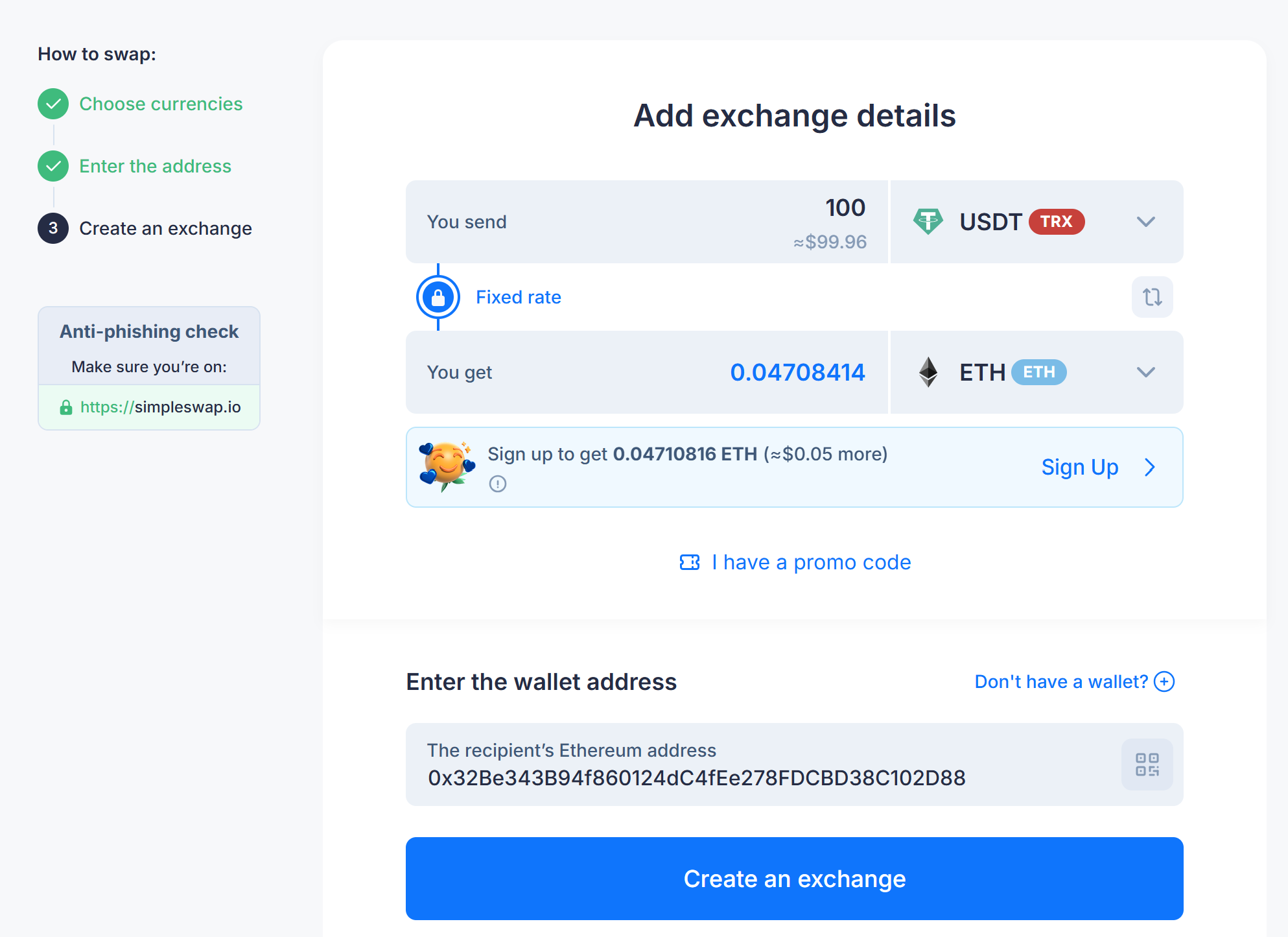
*The wallet address on the picture is provided for example purposes only, it is not a real one.
3. Click Exchange, paste your receiving address (so funds land where you’ll use them).
4. Confirm the rate and send your deposit.
5. Receive ETH (typically within minutes), no registration required.
Users can also use SimpleSwap to buy with crypto for fiat currency using debit or credit cards. On the coin pages it’s also possible to monitor the up-to-date prices and other key parameters.
Be sure to verify the ticker, chain, and the receiving address.
Two practical tips:
- Copy and paste the receiving address from your wallet, then re-check the first and last characters.
- Plan a little buffer so you are not left short on fees during the later steps.
Smart-contract risk deserves respect. Protocols can fail, audits are not guarantees, and user mistakes can be permanent. Research each protocol and start small if you are learning.
Litecoin: Everyday Transfers and Niche Payments
Litecoin tends to shine in simple, repeatable flows: sending funds to another wallet, moving value between platforms, or making a payment where LTC is accepted. People who care about quick confirmations and low fees often keep LTC in the toolbox for those moments.
Remittances can fit here too, especially when the goal is “fast and cheap” rather than app interaction. If you want to buy LTC for a transfer-focused use case, many swap services and wallets support that flow.
The ecosystem is smaller than Ethereum’s, so most LTC activity stays close to transfers and payments. That is not a disadvantage if your needs are simple. If you want a coin that behaves like money more than like an app platform, LTC often feels straightforward.
SimpleSwap is one place where customers may swap into LTC for a transfer-focused use case, though any broad crypto platform or wallet ecosystem can support the same pattern.
Which Is Better for You? Scenarios and Personas
Choosing between BTC, ETH, and LTC gets easier once you stop thinking in coin-vs-coin terms and start thinking in goal terms. “Which crypto is better” depends on whEther you want long-term holding, Web3 utility, low-cost transfers, or a mix.
Personas here are just quick sketches that match real user behavior. You can fit more than one persona at once, and many people shift over time as they learn.
Long-Term Saver or “Digital Gold” Believer
If you want simple exposure with a focus on scarcity and long-run recognition, BTC often fits this profile. Many long-term holders tend to focus on Bitcoin as a store-of-value crypto, then spend their learning energy on custody and risk management rather than chasing new apps.
The appeal is clarity: capped supply, strong network effects, deep liquidity, and a history of surviving stress. The cost is patience. Bitcoin’s base layer is not designed for constant feature expansion, and price swings can still be intense.
Web3 User and Yield-Seeker
If your interest centers on dApps, DeFi, NFTs, and staking, ETH tends to match the job. A typical Ethereum user might swap tokens on a DEX, deposit collateral to borrow, mint or trade NFTs, bridge funds to an L2, or stake ETH through a route they trust. This path rewards curiosity, yet it demands more caution.
Research protocols, read risk notes, and treat smart contracts like software that can break. “Ethereum staking” can add an income-like component for some users, though outcomes vary and depend on network conditions and chosen mEthod.
Frequent Spender and Cost-Conscious User
If you send crypto regularly, fees and confirmation cadence start to matter more than narratives. LTC often appeals to people who do routine transfers, small remittances, or frequent moves between platforms. Picture someone sending funds to family every month, or someone who shifts balances between services and wants a low-friction chain for the trip.
Litecoin for payments is not universal, yet its transfer niche stays relevant. The trade-off is limited access to complex on-chain applications compared with Ethereum.
Balanced or Diversified Approach
Many users land on a mix. They hold BTC for long-horizon conviction, keep ETH for Web3 exposure and utility, and add LTC as a practical transfer option when it fits their flow. A balanced approach is less about “collecting coins” and more about matching assets to roles.
This is where personal constraints matter: time horizon, risk tolerance, learning interest, and how often you actually transact. Some people dislike complexity and keep it BTC-heavy. Others live on-chain and treat ETH as their main working asset. Your mix can change as your habits change, and that is normal.
Round-Up
There is no single “best” coin across all goals. BTC, ETH, and LTC have stayed relevant for years since they solve different problems, and they make different trade-offs. If you keep your objective clear, the choice gets less emotional and more practical.
Here are the memorable one-liners that usually hold up:
- Bitcoin as a foundation and digital store of value.
- Ethereum as programmable infrastructure for DeFi, NFTs, and Web3.
- Litecoin as a pragmatic option for faster, lower-fee transfers.
The “right” fit depends on your time horizon, your comfort with volatility, and whEther you care more about Web3 use cases or simple holding and payments. Start with education and clear goals.
Experiment gradually rather than going all-in, and treat custody and address-checking as non-negotiable habits. Crypto is unforgiving with mistakes, even for experienced users. In practice, Bitcoin and Ethereum networks can feel very different even when both are used for holding and transfers.
FAQ
Is Bitcoin, Ethereum, or Litecoin Better for Beginners?
Beginners often start with BTC since it has the strongest name recognition and the simplest “what it does” story. After that, many explore ETH once they want to understand smart contracts, DeFi, or staking, and some add LTC once they care about low-cost transfers.
A steady learning approach usually works better than chasing fast gains. Start small, focus on how transactions and custody work, and get comfortable reading fees and confirmations before trying complex on-chain apps.
Which is Safer: Bitcoin, Ethereum, or Litecoin?
All three are established networks with long operating histories, yet none are risk-free. BTC and ETH tend to benefit from higher liquidity and stronger network effects, which can help during periods of stress. LTC is smaller, yet it is still long-standing and widely supported.
“Safer” can mean different things. Technological maturity and liquidity are not the same as price stability. All three can swing sharply. Diversification and proper storage are two of the biggest levers for managing risk, and neither requires predicting the market.
Can I Use All Three Coins in One Portfolio?
Yes, many users do. A common high-level pattern is BTC for long-term holding, ETH for Web3 exposure and on-chain utility, and LTC for payments or transfers when low fees and quicker confirmations matter.
Another pattern is simpler: BTC as the core, ETH as a smaller “utility” position for apps, and LTC as an occasional tool rather than a long-term focus. The best blend is the one you can explain in one sentence and stick to through volatility.
How Do Transaction Fees Compare Between Bitcoin, Ethereum, and Litecoin?
LTC typically offers low, predictable fees for routine transfers. Ethereum fees can spike during high demand, and they tend to reflect how busy the network is plus what kind of action you are taking. Bitcoin fees vary with congestion and can be higher than LTC ones during busy periods.
Some users manage fee impact by choosing the right network for the job. Transfers may suit LTC, app interactions may require ETH, and BTC may be reserved for higher-value settlement or long-horizon storage.
Do I Need Different Wallets for BTC, ETH, and LTC?
Many modern wallets support multiple networks, so you may not need separate apps. Still, addresses and standards differ across Bitcoin, Ethereum, and Litecoin. You must verify that your wallet supports the specific coin and network you plan to use.
Never send funds to an incompatible address type. Double-check the first and last characters, confirm the network selection, and run a small test transfer if you feel uncertain.
Is Ethereum Better Than Litecoin?
It depends on your goal. If you plan to use Web3 apps, interact with DeFi, trade NFTs, or stake within Ethereum’s ecosystem, ETH is usually the better fit. If your main need is moving value cheaply with quick confirmations and minimal complexity, LTC often fits better. A simple chooser: if using Web3, pick ETH. If moving value for transfers and payments, look at LTC.
What Are the Advantages of Litecoin?
Litecoin’s main advantages are practical: faster blocks than Bitcoin, a long-running network with broad support, and a payments and transfer niche that many users find convenient. Fees are often low for typical transfers, and confirmation cadence can feel smoother than BTC for everyday sending.
These strengths do not make LTC “the best” across every use case. They make it a useful tool for specific jobs, especially transfers where speed and cost predictability matter most.
Can I Use All Three Coins in One Portfolio?
Yes, many users do. A common high-level pattern is BTC for long-term holding, ETH for Web3 exposure and on-chain utility, and LTC for payments or transfers when low fees and quicker confirmations matter.
Another pattern is simpler: BTC as the core, ETH as a smaller “utility” position for apps, and LTC as an occasional tool rather than a long-term focus. The best blend is the one you can explain in one sentence and stick to through volatility.
How Do Transaction Fees Compare Between Bitcoin, Ethereum, and Litecoin?
LTC typically offers low, predictable fees for routine transfers. Ethereum fees can spike during high demand, and they tend to reflect how busy the network is plus what kind of action you are taking. Bitcoin fees vary with congestion and can be higher than LTC ones during busy periods.
Some users manage fee impact by choosing the right network for the job. Transfers may suit LTC, app interactions may require ETH, and BTC may be reserved for higher-value settlement or long-horizon storage.
Do I Need Different Wallets for BTC, ETH, and LTC?
Many modern wallets support multiple networks, so you may not need separate apps. Still, addresses and standards differ across Bitcoin, Ethereum, and Litecoin. You must verify that your wallet supports the specific coin and network you plan to use.
Never send funds to an incompatible address type. Double-check the first and last characters, confirm the network selection, and run a small test transfer if you feel uncertain.
Is Ethereum Better Than Litecoin?
It depends on your goal. If you plan to use Web3 apps, interact with DeFi, trade NFTs, or stake within Ethereum’s ecosystem, ETH is usually the better fit. If your main need is moving value cheaply with quick confirmations and minimal complexity, LTC often fits better.
A simple chooser works here: if using Web3, pick ETH. If moving value for transfers and payments, look at LTC.
What Are the Advantages of Litecoin?
Litecoin’s main advantages are practical: faster blocks than Bitcoin, a long-running network with broad support, and a payments and transfer niche that many users find convenient. Fees are often low for typical transfers, and confirmation cadence can feel smoother than BTC for everyday sending.
These strengths do not make LTC “the best” across every use case. They make it a useful tool for specific jobs, especially transfers where speed and cost predictability matter most.
The information in this article is not a piece of financial advice or any other advice of any kind. The reader should be aware of the risks involved in trading cryptocurrencies and make their own informed decisions. SimpleSwap is not responsible for any losses incurred due to such risks. For details, please see our Terms of Service.


